

An emergency call that sounds like a child, parent, grandchild, co-worker, or public official is not enough proof by itself anymore. Voice-cloning tools can make a scam feel personal, urgent, and hard to question.
The practical rule is simple: pause before sending money, moving cryptocurrency, buying gift cards, clicking a link, or sharing an account code. A real emergency can usually survive a short verification step. A scam often depends on stopping you from taking that step.
The FBI's 2025 Internet Crime Report said the Internet Crime Complaint Center received 22,364 complaints involving AI-related information, with adjusted losses of $893,346,472. The report specifically described distress scams where voice cloning is used to mimic a loved one in trouble.
Do this first
If a call or voice message claims someone needs money immediately, move through these checks before taking action.
- Hang up or stop replying. Do not keep the caller on the line while you verify.
- Call the person back using a number already saved in your contacts, not a number the caller gives you.
- Try a second route, such as another family member, a trusted friend, a school, a workplace, or a known office number.
- Ask a prearranged family verification question or code phrase that is not posted online.
- Refuse payment by gift card, wire transfer, crypto, payment app, or cash courier until the story is independently confirmed.
The Federal Trade Commission gives the same basic warning for family-emergency schemes: do not trust the voice alone. Verify the story through a known number, and treat hard-to-reverse payment requests as a major warning sign.
Build a family verification plan
The best time to make a plan is before a call arrives. Pick one short code phrase with close relatives or trusted contacts. It should be easy to remember, boring enough not to post online, and not based on public information such as a birthday, pet name, school, hometown, or sports team.
Also agree on the backup path. For example: if someone claims to be in jail, in the hospital, stranded while traveling, or locked out of an account, the family rule can be that another person must be contacted before money moves. That makes the plan less dependent on one scared person making a perfect decision under pressure.
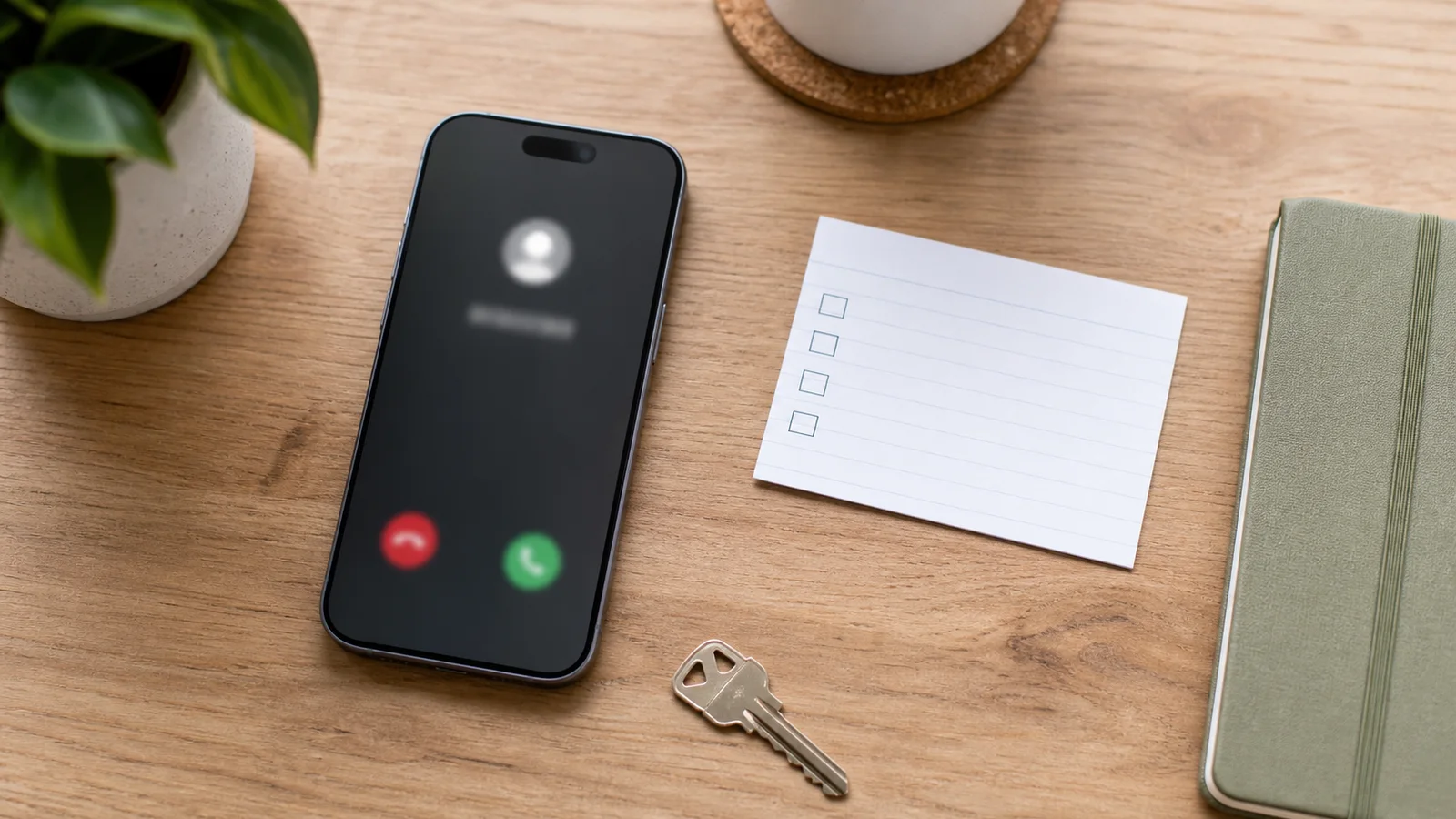
Check these details
Caller ID is not proof. A number can be spoofed, and scammers may use personal details found online to make the story sound believable. Be especially careful if the caller asks you to switch to a new messaging app, click a link, share a one-time code, or keep the request secret.
The FBI's May 2025 warning on smishing and vishing said AI-generated voices can be used to impersonate public figures or personal relations. Its mitigation advice is to independently verify the person, number, organization, and request before responding.
The Federal Communications Commission also changed the enforcement landscape on February 8, 2024, when it said AI-generated voices in robocalls are treated as artificial voices under the Telephone Consumer Protection Act. That gives regulators and state attorneys general more tools, but it does not remove the need for personal verification. Scam attempts can still arrive as direct calls, texts, voice memos, or messages on other platforms.
Common mistakes
Do not test the caller by asking facts that can be found online. A scammer may know relatives' names, travel plans, a school, an employer, or recent social-media posts. Use a private verification step instead.
Do not let embarrassment speed you up. Scammers often ask victims not to tell anyone because the supposed emergency is humiliating, legal, medical, or work-related. That secrecy is part of the pressure tactic.
Do not assume a bank, government agency, law firm, hospital, police department, utility, or tech-support desk needs payment in gift cards or cryptocurrency. If an institution is named, find its official number yourself and call directly.
When to get help
If money has already moved, contact the bank, card issuer, payment app, crypto exchange, wire service, or gift-card company immediately. Ask whether the payment can be stopped, reversed, frozen, or traced. Keep receipts, wallet addresses, phone numbers, usernames, texts, emails, voicemails, and dates.
Report suspected fraud to the FTC at ReportFraud.ftc.gov and to the FBI's IC3 at ic3.gov. Reporting may not guarantee recovery, but it gives investigators details they can connect across cases.
The bottom line: treat a familiar voice as a clue, not a credential. Pause, use a known contact path, and require one independent confirmation before money or account access changes hands.


