
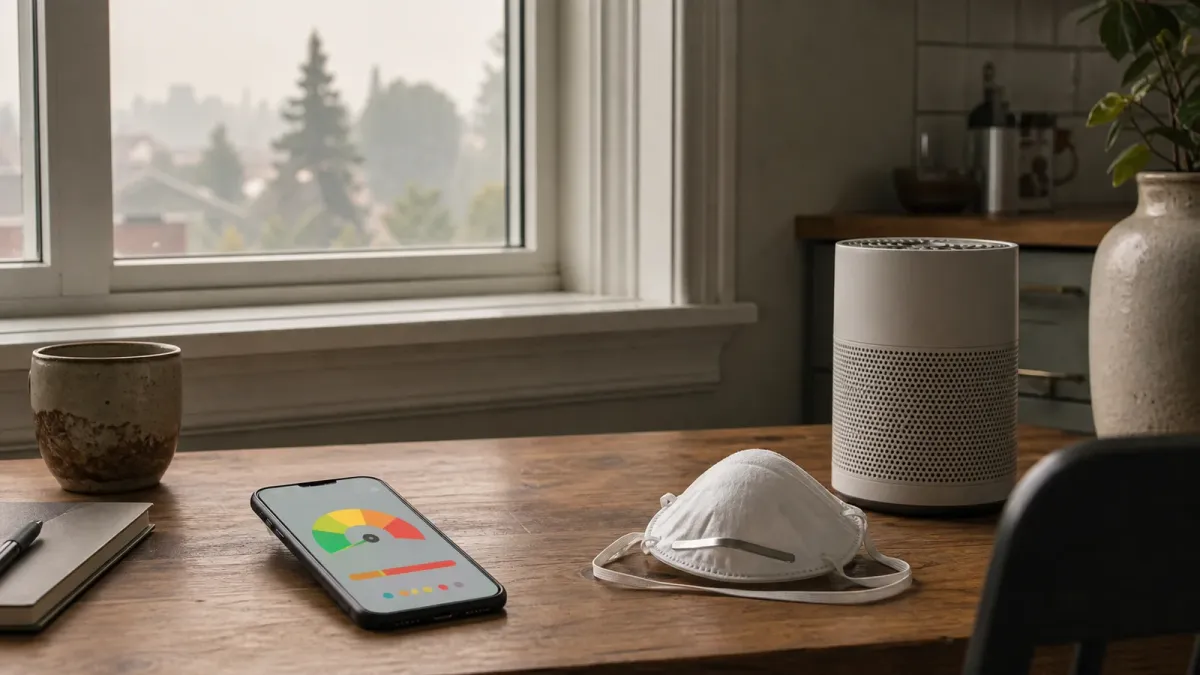
Air quality alerts can move faster than a daily weather plan. On Wednesday, July 15, 2026, the National Weather Service listed air quality alerts across parts of Indiana, Michigan, Maryland, Ohio, Colorado and New York, including fine-particle alerts tied to wildfire smoke and ozone action days.
The useful habit is simple: check the AQI before you exercise, commute with children, open windows or run errands. AirNow, the federal air quality site, uses the Air Quality Index to turn pollution levels into six color categories that are easier to act on than raw particle or ozone readings.
The short answer
Green means air quality is generally good. Yellow is acceptable for most people, though unusually sensitive people may need to scale back. Orange means people in sensitive groups should limit prolonged or heavy outdoor activity. Red means some people in the general public may feel effects, while sensitive groups face higher risk. Purple and maroon are health alerts for everyone.
Do this first
- Check AirNow or your local air agency before outdoor exercise, youth sports, yard work or long errands.
- If the AQI is orange or worse, move hard workouts indoors or shorten them.
- Keep windows closed when smoke is at ground level, especially overnight.
- Run a portable air cleaner, or use a central air system with a high-efficiency filter if your system can handle it.
- If you must go outside during smoke, use a well-fitting N95 or similar respirator rather than a loose cloth mask.
Check these details
Do not rely only on whether the sky looks hazy. Wildfire smoke can sit high above the ground, while fine particles near street level can be harder to see. Also check which pollutant is driving the alert. Smoke events usually center on fine particle pollution, or PM2.5. Hot, stagnant days often bring ozone alerts, which can be worse in the afternoon and early evening.
Common mistakes
The biggest mistake is treating orange as harmless because it is not red. Orange is already the point where children, older adults, pregnant people, outdoor workers, and people with asthma, COPD, heart disease or other respiratory conditions should be more cautious. Another mistake is opening windows for a breeze when outdoor smoke is the problem. That can bring particles indoors and make the cleanest room in the home less useful.
When to get help
Follow instructions from local emergency managers and health agencies. CDC guidance says people with heart or lung conditions, diabetes, chronic kidney disease, pregnancy, or new or worsening symptoms should be especially careful during wildfire smoke. If breathing trouble, chest tightness, dizziness, wheezing or severe symptoms develop, seek medical advice promptly. For planning, use the AirNow Fire and Smoke Map and local alerts rather than a single screenshot from earlier in the day.
Sources: National Weather Service air quality alerts, AirNow AQI Basics, CDC wildfire smoke safety guidance, and EPA wildland fires and smoke guidance.


