
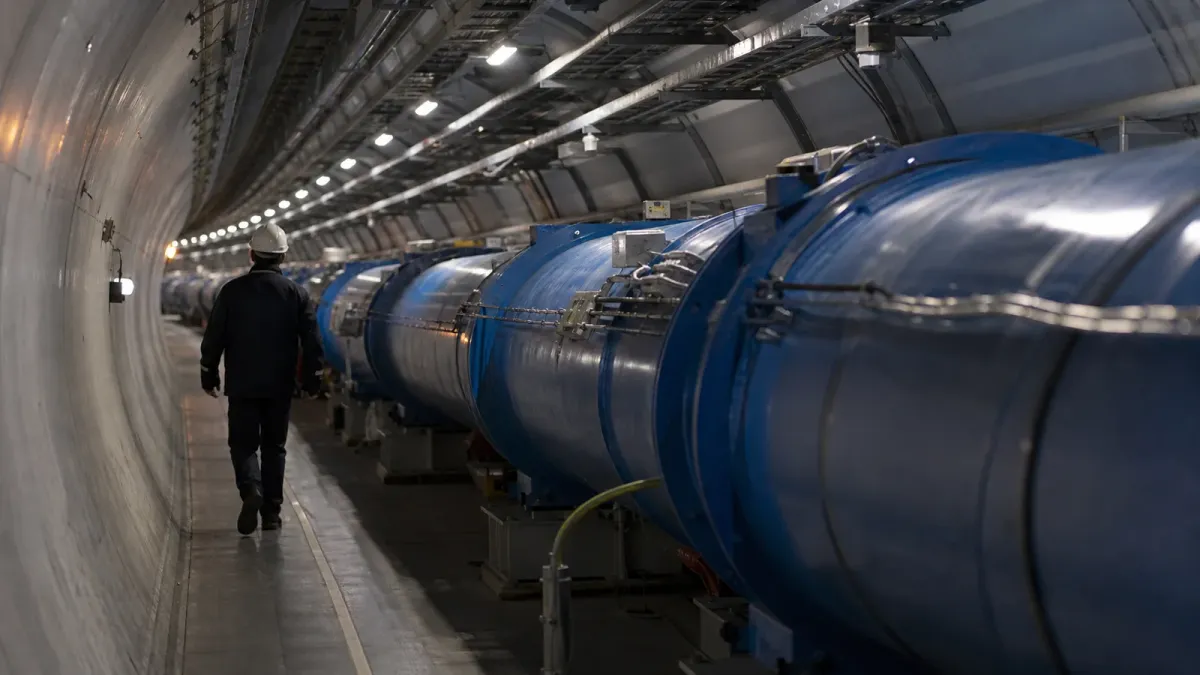
CERN has switched off the Large Hadron Collider for a planned four-year overhaul, bringing its third data-taking run to an end and starting the machine's most ambitious upgrade yet. The shutdown began after the final protons of Run 3 circulated on June 27, 2026, and the accelerator is expected to return in 2030 as the High-Luminosity Large Hadron Collider.
The phrase "CERN shutdown" can make the development sound sudden or ominous. It is neither. CERN remains an active research organization, and the pause applies to the LHC's collision program while engineers replace equipment, strengthen infrastructure and rebuild major detector systems.
The short answer
The LHC needs to be opened and partially rebuilt before it can produce many more particle collisions. Scientists call this period Long Shutdown 3. When the collider returns, higher "luminosity" will let researchers collect far more data, improving their odds of seeing rare particle processes and making more precise measurements.
What is changing
The LHC is a 27-kilometer, or nearly 17-mile, underground ring near Geneva that accelerates particles to almost the speed of light. Science News reports that about 1.2 kilometers of accelerator components will be removed and replaced during the upgrade. New magnets and other systems will focus the proton beams more tightly at the collision points.
The experiments surrounding those collision points also need major work. ATLAS says its overhaul includes a new all-silicon inner tracker with 5 billion readout channels, a precision timing detector and faster electronics and computing systems. Those upgrades are necessary because the future machine is expected to create about 200 proton-proton collisions each time the beams cross.
Does science stop during the shutdown?
No. Researchers still have an enormous backlog of collision data to analyze. CERN says the LHC delivered 54 million billion proton collisions to each of the ATLAS and CMS experiments across its three high-energy runs. ATLAS alone recorded most of its lifetime proton-collision dataset during Run 3, and its collaboration expects the analysis period to remain highly productive.
Work elsewhere at CERN also follows its own schedule. The shutdown is a coordinated engineering program across the accelerator complex, not the closure of the laboratory or the end of particle-physics research.
Why the 2030 restart matters
The original LHC enabled the 2012 discovery of the Higgs boson and increasingly precise tests of the Standard Model, the framework physicists use to describe known fundamental particles and forces. But questions about dark matter, the imbalance between matter and antimatter and other unexplained phenomena remain.
The High-Luminosity LHC is designed to provide a much larger statistical sample, including data from hundreds of millions of Higgs bosons over its operating life. More collisions do not guarantee a new discovery, but they give scientists a sharper tool for detecting subtle departures from existing theory.
What to watch
The key milestone is the planned return of particle beams in 2030. Until then, expect updates about new magnets, detector installations and commissioning tests. The most important point is simple: the LHC was not shut down because something went wrong. It was deliberately taken offline so teams can build the machine intended to carry particle physics into its next phase.


