
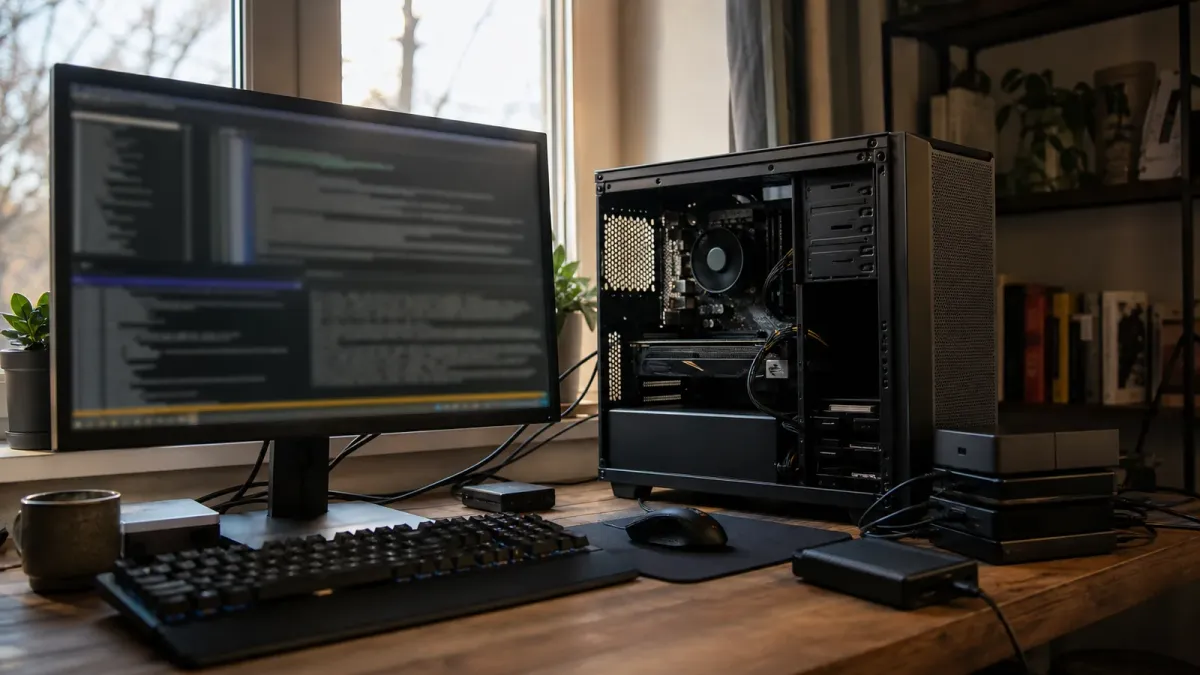
A new open-source project is showing that an enormous artificial intelligence model can run on an ordinary computer with about 25 GB of memory. The claim is real, but the experience is nothing like a fast cloud chatbot.
The project, called Colibrì, runs GLM-5.2, a mixture-of-experts model that the engine describes as having 744 billion parameters. Instead of loading the entire model into expensive GPU memory or system RAM, Colibrì keeps a relatively small portion in memory and pulls specialized sections from a local solid-state drive as they are needed.
On the developer's 12-core Windows Subsystem for Linux test machine, the model occupied about 370 GB on disk, used roughly 20 GB of memory during a chat and generated only about 0.05 to 0.1 token per second when the cache was cold. That can mean waiting many seconds for each small fragment of an answer.
The short answer
Yes, a model of this size can technically run on a consumer machine without a GPU. No, that does not make it a practical replacement for a normal interactive chatbot on low-end hardware.
Colibrì matters because it demonstrates a different way to think about local AI hardware. Storage, system memory and optional graphics memory can be treated as levels in one larger memory hierarchy. The system still needs access to all the model data, but not every piece has to occupy the fastest and most expensive memory at the same time.
How Colibrì makes the model fit
GLM-5.2 uses a mixture-of-experts architecture. Although the model has hundreds of billions of total parameters, only a fraction are active for a given token. A routing system selects the expert components needed for the next step of generation.
According to the Colibrì repository, roughly 17 billion dense parameters—including attention layers, shared experts and embeddings—remain resident in RAM after four-bit quantization. That portion takes about 9.9 GB. The project's 21,504 routed experts live in a roughly 370 GB container on an NVMe drive and are streamed into memory on demand.
Quantization is also essential. It represents model weights with fewer bits, sharply reducing storage and memory requirements. The tradeoff is that lower precision can affect quality, and the project says more testing is needed to separate quantization effects from limitations in its early benchmark methods.
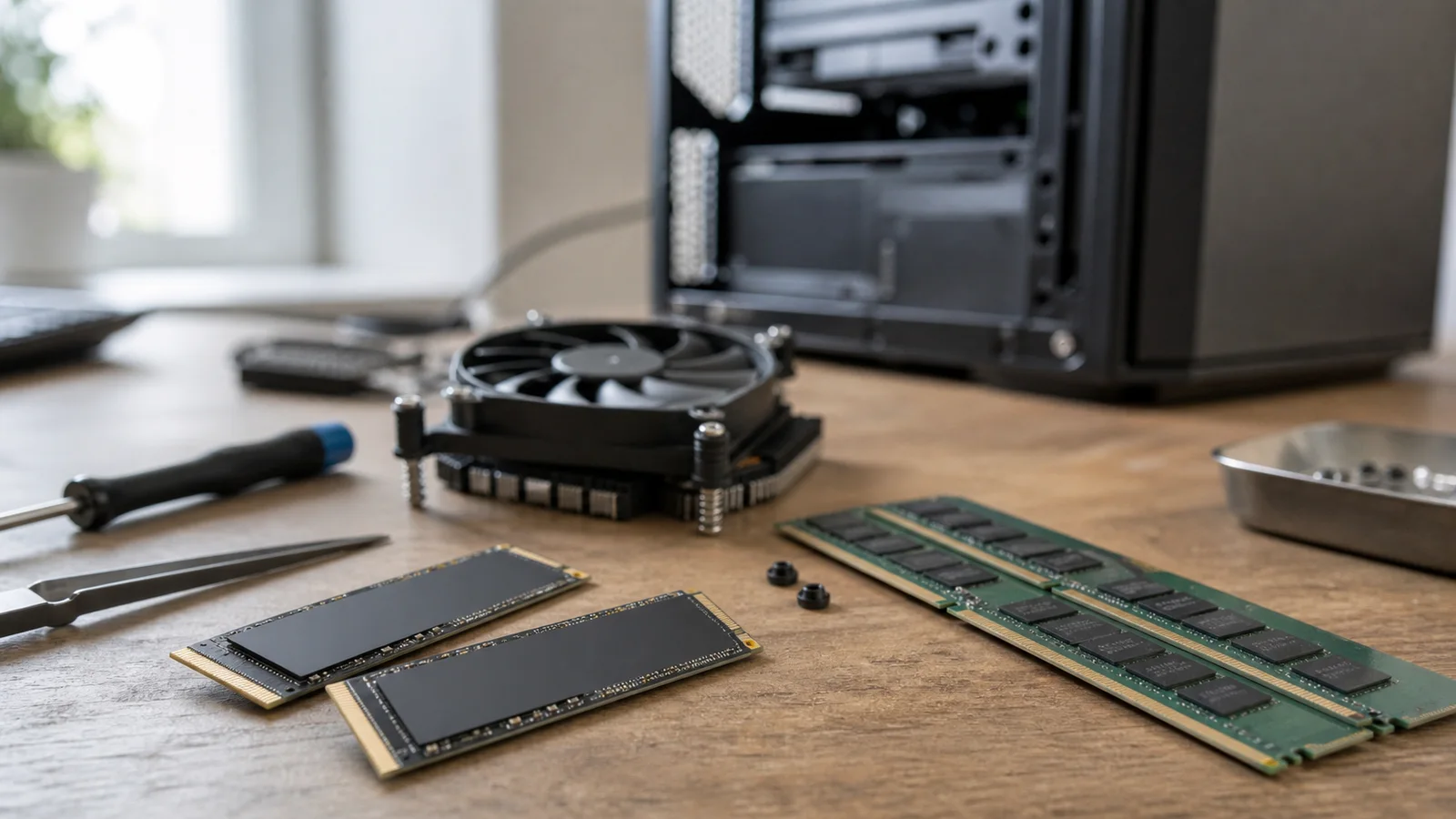
The catch is storage speed
The low-memory approach does not eliminate the model's data requirements. It moves the bottleneck. Colibrì estimates that a cold token can require about 11 GB of disk reads as the engine works through 75 mixture-of-experts layers. On the developer's drive, which delivered about 1 GB per second for the relevant workload, cold generation reached roughly 0.05 to 0.1 token per second.
More memory can cache frequently used experts, while faster storage reduces the wait for uncached ones. Community results listed by the project show an Apple M5 Max system with 128 GB of unified memory reaching about 1.06 token per second in one configuration. A warmer, tuned Metal run reached higher speeds, but those systems remain far from the rapid output people expect from mainstream cloud services.
The repository is unusually direct about this limitation: the proof is that the model can answer, not that it is fast. Independent coverage from Tom's Hardware similarly characterized the project as a promising proof of concept whose low-memory baseline is too slow for ordinary conversation.
Why the experiment matters
Local AI is usually framed as a choice between smaller models that fit comfortably on consumer hardware and very large models that require costly servers. Colibrì suggests a third option: retain access to a much larger model while accepting slower generation and carefully managing which weights occupy fast memory.
That approach could be useful for experiments where privacy, offline access or model capability matters more than immediate answers. It may also influence other inference systems as developers improve prefetching, caching, compression and CPU kernels.
GLM-5.2 itself is available under an MIT license. Its official model card describes a one-million-token context window and improvements for long-horizon and coding tasks. A separate preconverted Colibrì container is available through Hugging Face, but it requires roughly 400 GB of free local NVMe storage along with a supported operating system, compiler and modern CPU instructions.
What to watch next
The important question is no longer whether the technique can produce an answer. It is how much faster it can become without requiring so much memory that the original advantage disappears.
Community benchmarks will be especially useful because storage controllers, filesystems, RAM capacity and CPU instruction support can change the result dramatically. For now, Colibrì is best understood as an engineering demonstration: a 744-billion-parameter model can fit into a consumer workflow, but fitting is not the same as running well.


