
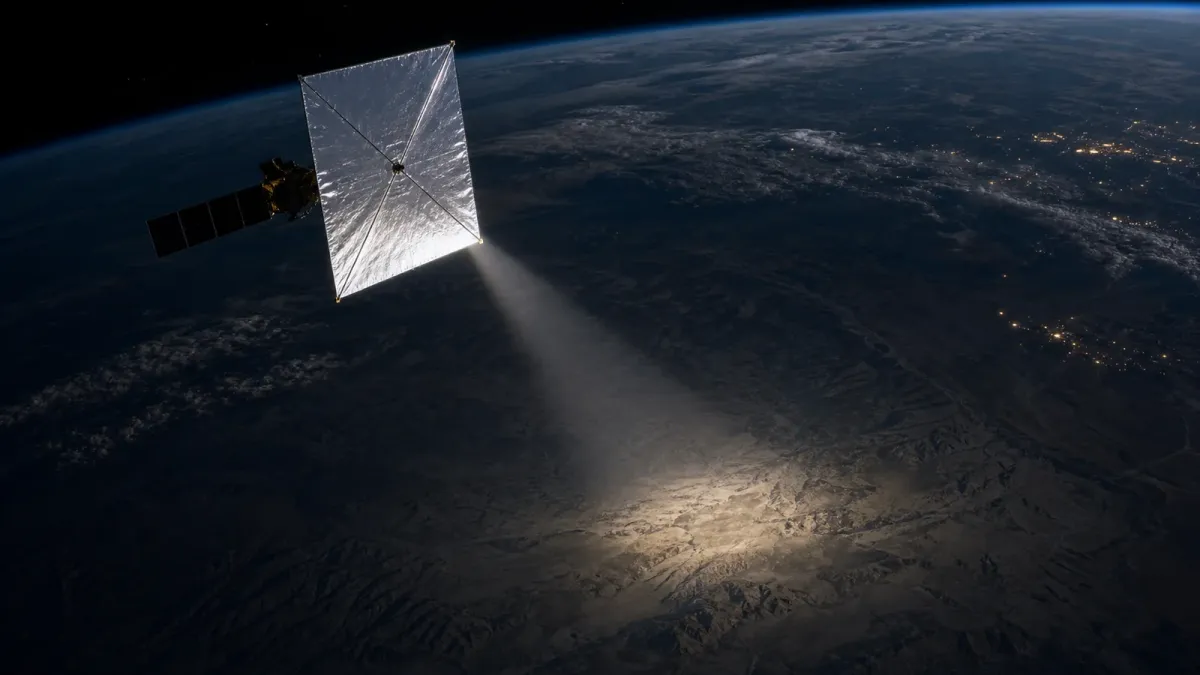
The Federal Communications Commission has cleared Reflect Orbital to deploy and operate Earendil-1, a single demonstration satellite designed to test whether a large reflector in low Earth orbit can redirect sunlight toward the ground at night.
The order was adopted and released on July 9, 2026. It gives the company conditional authority to use radio links for a short-duration test mission, not permission to build the much larger constellation that has drawn public attention and scientific criticism.
The short version
Earendil-1 is meant to test a deployable, steerable thin-film reflector. In its order, the FCC described the satellite as a limited technology demonstration that would help show whether the concept is technically viable and what problems a future version would need to solve.
The authorization lists a non-geostationary orbit, with operations around 625 kilometers in altitude and an 88-degree inclination. The license term is two years once Reflect Orbital certifies the spacecraft has been successfully placed into orbit and is operating under the order's conditions.
What the test could do
Reflect Orbital has pitched the technology as a way to direct reflected sunlight to targeted areas after dark, potentially extending useful hours for solar power, remote operations, emergency response, or other work that needs temporary illumination.
The American Astronomical Society says the proposed Earendil-1 spacecraft would use an 18-meter by 18-meter mirror and could create a roughly 5-kilometer-wide beam on the ground. The society says it has raised concerns about optical astronomy, radio astronomy, pilots, drivers, wildlife, and the natural nighttime environment.
What the approval does not settle
The biggest point for readers is scope. The FCC order is about one satellite and its communications authority. The agency said concerns tied to a future large constellation did not justify denying this single-satellite application or adding more conditions to this authorization.
That does not mean a constellation is approved. A broader deployment would still need additional regulatory steps, and the test data could shape whether the company, customers, researchers, and regulators see the idea as practical or too disruptive.
What to watch next
Reflect Orbital must meet the order's conditions, including a surety bond deadline on August 10, 2026. The company also must place Earendil-1 into the assigned orbit and operate it under the authorization by July 9, 2032, unless the FCC grants an extension.
The real test will come after launch: whether the reflector can be aimed precisely, how bright it appears from the ground, and whether the measured effects answer the concerns raised by astronomers and dark-sky advocates. For now, the approval starts one experiment, not a new nighttime lighting system.


