
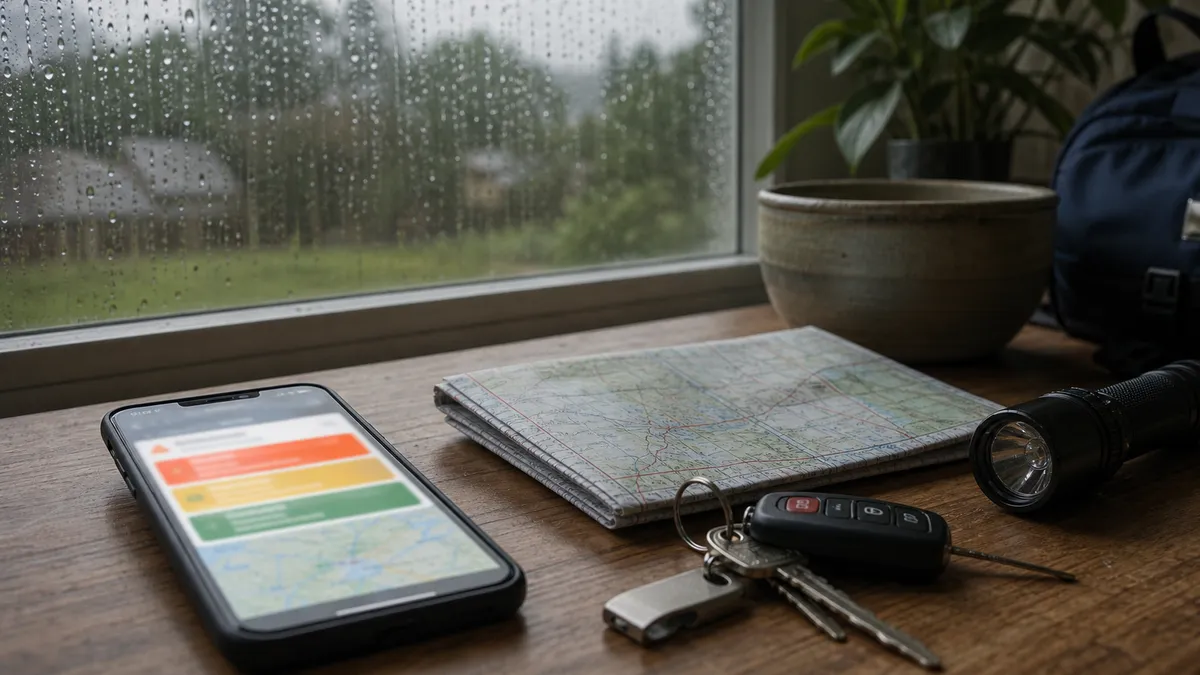
Flash-flood language can sound technical until the alert arrives on your phone. The key distinction is simple: a watch means conditions are favorable, while a warning means flooding is imminent or already happening.
The difference matters this week because the National Weather Service's Weather Prediction Center said on July 7, 2026, that parts of the Northern Plains, the Mid-Atlantic and northwest Louisiana had a slight risk of excessive rainfall, with slow-moving downpours capable of producing localized flash flooding.
This guide is not a replacement for local emergency instructions. It is a quick way to decode the alert and decide what to do first.
The short answer
Flood watch: Be ready. Conditions are favorable for flooding, but flooding is not certain. Charge your phone, check your local forecast, clear drains if you can do so safely, and know where higher ground is.
Flood warning: Take action. The National Weather Service uses a flood warning when flooding is imminent or occurring. Follow evacuation orders, avoid flooded roads, and move away from low-lying areas.
Flash flood warning: Act immediately. NWS says this alert is issued when a flash flood is imminent or occurring. If you are in a flood-prone place, move to higher ground right away. Flash flooding can develop in minutes and can happen even where rain is not falling directly overhead.
Flood advisory: Be aware. This is for flooding that is expected to cause inconvenience but is not severe enough for a warning. Treat it seriously, especially if you drive through underpasses, live near small streams, or are in an urban area with poor drainage.
Do this first
If a flash flood warning hits your phone, do not spend the first minutes trying to compare radar apps. Move people and pets to higher ground, away from basements, underpasses, drainage channels and low-water crossings.
If you are driving and see water over the road, turn around. NWS flood-safety guidance says fast-moving water can knock over an adult at about 6 inches, carry away most cars at about 12 inches, and carry away SUVs and trucks at about 2 feet. Depth is hard to judge, especially at night, and the road surface may be damaged below the water.
If officials tell your area to evacuate, use the posted route rather than a shortcut. The American Red Cross also advises checking on neighbors and loved ones when it is safe to do so, because a text or call may help someone who missed an alert.
Check these details
Look at the alert type, the affected location, the expiration time and the recommended action. A watch can be upgraded. A warning can be extended. A narrow warning polygon may not match county lines, so check whether your home, workplace, school or commute route is inside the alert area.
For planning, the Weather Prediction Center's Excessive Rainfall Outlook is useful because it shows where heavy rain could exceed flash-flood guidance over the next several days. For immediate decisions, your local NWS office, emergency management agency and wireless emergency alerts should take priority.
Common mistakes
The biggest mistake is treating a watch as a reason to wait until roads are already underwater. The second is assuming a familiar road is safe because it was passable earlier. The third is walking through floodwater after the rain stops. Floodwater can hide debris, downed wires, contamination and washed-out pavement.
When to get help
Call emergency services if someone is trapped, water is entering a building quickly, or you see a life-threatening situation. For cleanup, wait until officials say it is safe to return, avoid wet electrical equipment, and follow local public-health advice for food, drinking water and protective gear.


