
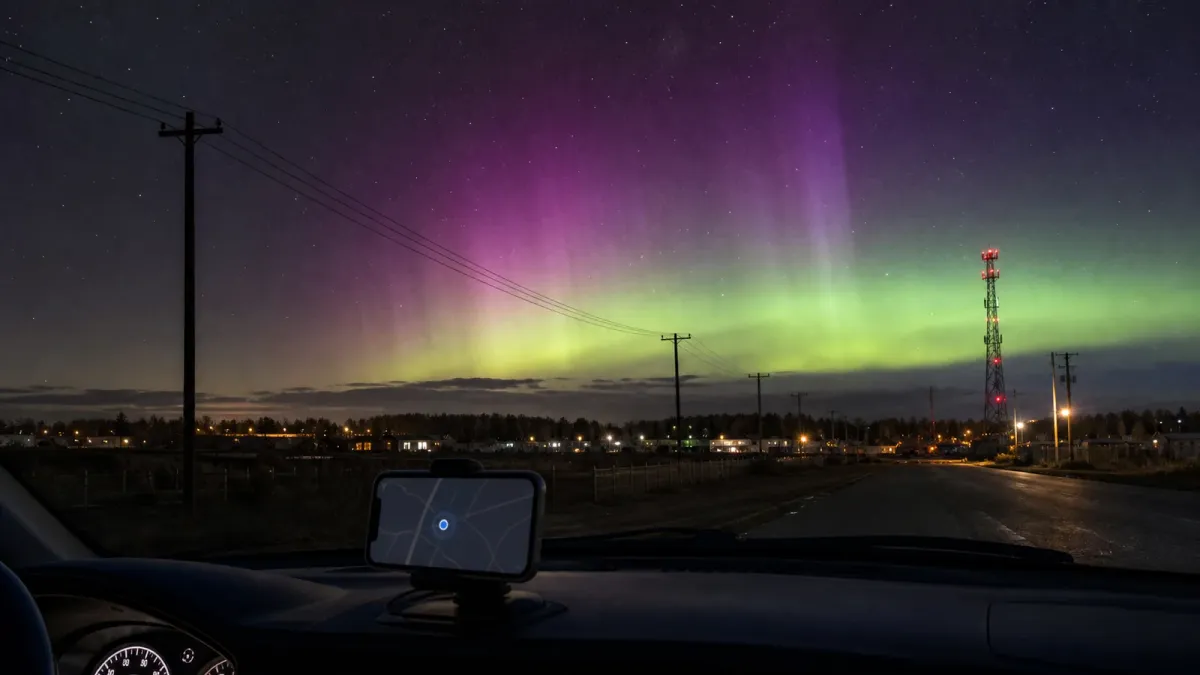
A geomagnetic storm is a disturbance in Earth's magnetic environment caused by activity from the Sun. It can produce vivid auroras, but the same physics can also interfere with systems that depend on satellites, radio signals or long electrical conductors.
NOAA describes storm strength with a five-level G-scale. G1 means minor and G5 means extreme. The scale is designed for technical impacts, not personal danger on the ground.
NASA says Earth's atmosphere and magnetic field protect people at the surface from the worst effects of solar storms. Most readers do not need to shelter during a geomagnetic warning, though utilities, satellite operators, airlines and other infrastructure providers may take precautions.
The short answer
The Sun constantly sends out a stream of charged particles called the solar wind. Sometimes it also ejects a large cloud of plasma and magnetic field known as a coronal mass ejection, or CME.
If the CME reaches Earth with the right magnetic orientation, it can transfer energy into the magnetosphere and set off a geomagnetic storm. A CME commonly takes roughly 30 to 72 hours to arrive, while measurements from spacecraft near Earth may provide only a shorter final warning about the storm's exact strength.
What the G-scale means
- G1, minor: Weak power-grid fluctuations may occur, small satellite effects are possible, and aurora may reach farther from the poles than usual.
- G2, moderate: High-latitude power systems may see voltage alarms, spacecraft operators may need corrections, and high-frequency radio can fade at higher latitudes.
- G3, strong: Voltage corrections may be required, satellite navigation and low-frequency radio can become intermittent, and aurora can move substantially southward.
- G4, severe: Power-control problems become more widespread, satellite tracking can degrade, and high-frequency radio may be unreliable across broader areas.
- G5, extreme: NOAA warns of possible widespread grid-control problems, transformer stress, major satellite and navigation disruption, and aurora visible unusually far from the poles.
The duration matters as well as the peak level. A brief reading and a long storm at the same category may not produce identical impacts.
How technology can be affected
Changing magnetic fields can induce electrical currents in the ground and in long conductors. Those currents can enter high-voltage transmission systems and pipelines. Grid operators monitor forecasts so they can adjust operations before the strongest disturbances arrive.
Geomagnetic activity also changes the ionosphere, the charged upper layer of the atmosphere through which many radio and navigation signals travel. GPS positions can lose accuracy, high-frequency radio links can weaken and aviation or maritime users may need alternate methods.
Heating in the upper atmosphere increases drag on low-Earth-orbit satellites. That can alter orbits, complicate tracking and require operators to make corrections. Satellite electronics and communications can also experience errors during stronger space-weather events.
What ordinary readers should do
For most households, a geomagnetic storm is mainly an aurora opportunity and a reason to follow credible forecasts. Check NOAA's Space Weather Prediction Center for official alerts rather than relying on screenshots of model maps circulating on social media.
If a G4 or G5 warning coincides with local emergency advice, keep normal outage supplies ready: charged phones, flashlights and a way to receive information. Avoid assuming that every warning means a blackout; the scale describes potential effects, and operators actively manage the risk.
Photographers should seek a dark northern horizon, allow eyes time to adjust and check terrestrial weather first. Clouds, city light and moonlight can hide an aurora even when geomagnetic conditions are favorable.
What to watch
A solar flare, a radiation storm and a geomagnetic storm are related but different events, with separate NOAA scales. The most useful public signal is the current official alert and its expected timing, not the size of an eruption image alone.
The bottom line: geomagnetic storms are real infrastructure hazards at high levels, but they are monitored continuously. For most people, informed attention—not panic—is the appropriate response.


