
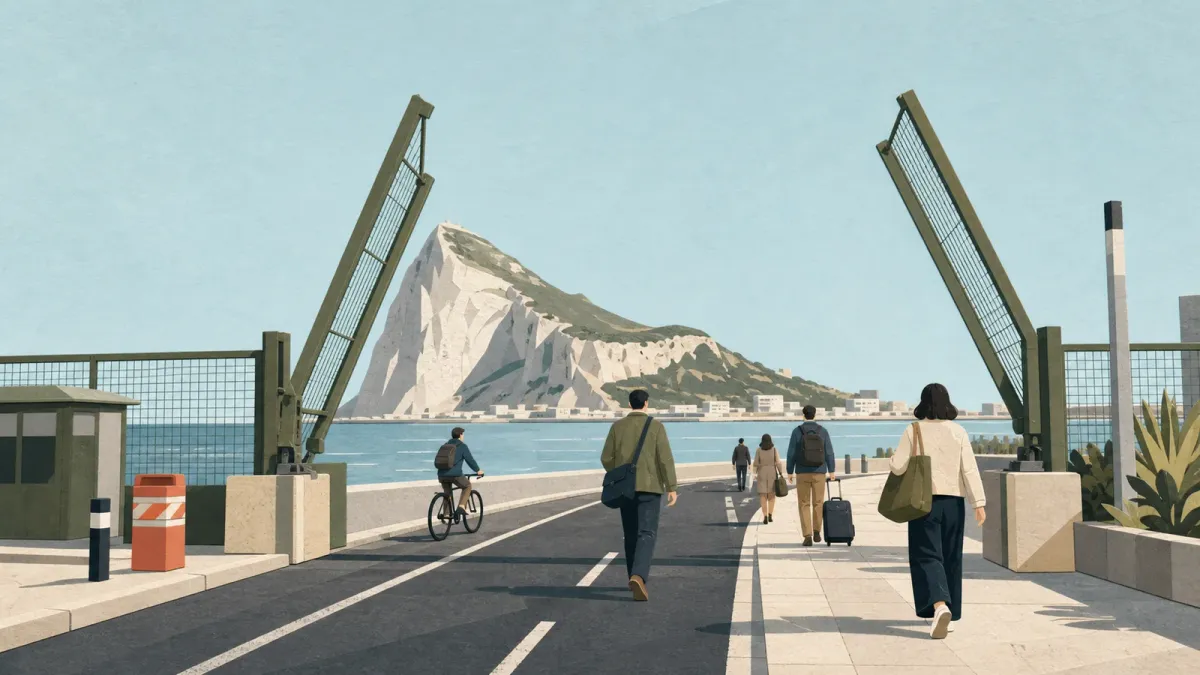
Gibraltar's land border with Spain changed overnight on Wednesday, July 15, 2026, when the frontier fence came down and routine checks at the crossing with La Linea de la Concepcion ended under a new European Union-United Kingdom treaty.
The move is practical as much as symbolic: it is meant to make daily life easier for thousands of workers, families, shoppers and visitors who move between southern Spain and the British overseas territory. It also closes one of the last unresolved border questions left by Brexit.
The UK government said the treaty was signed in Brussels on July 14 and would be applied provisionally from July 15. The European Commission's representation in Spain said the agreement follows more than four years of negotiations and is designed to give legal certainty to residents while protecting the EU's Schengen area, single market and customs union.
What changed
The old land-frontier routine is gone. People crossing between Gibraltar and Spain no longer face the same physical barrier and regular passport checks at the road and pedestrian crossing, according to Associated Press reporting from the scene.
That matters because Gibraltar's economy relies heavily on cross-border movement. The UK government said roughly 15,000 people, more than half of Gibraltar's workforce, cross the land border each day. Long queues or a hard post-Brexit border would have created a direct cost for employers, workers and nearby communities in Andalusia.
The change does not make Gibraltar part of Spain, and it does not settle the sovereignty dispute that has lasted for centuries. Gibraltar remains a British overseas territory. Spain maintains its claim, while the UK and Gibraltar say the treaty safeguards British sovereignty and military operations.
Where checks move now
The main border-control question moves away from the land crossing and toward Gibraltar's airport and port. AP reported that entry and exit checks there will be conducted by UK and Spanish border officials, similar to paired controls used at some international rail terminals.
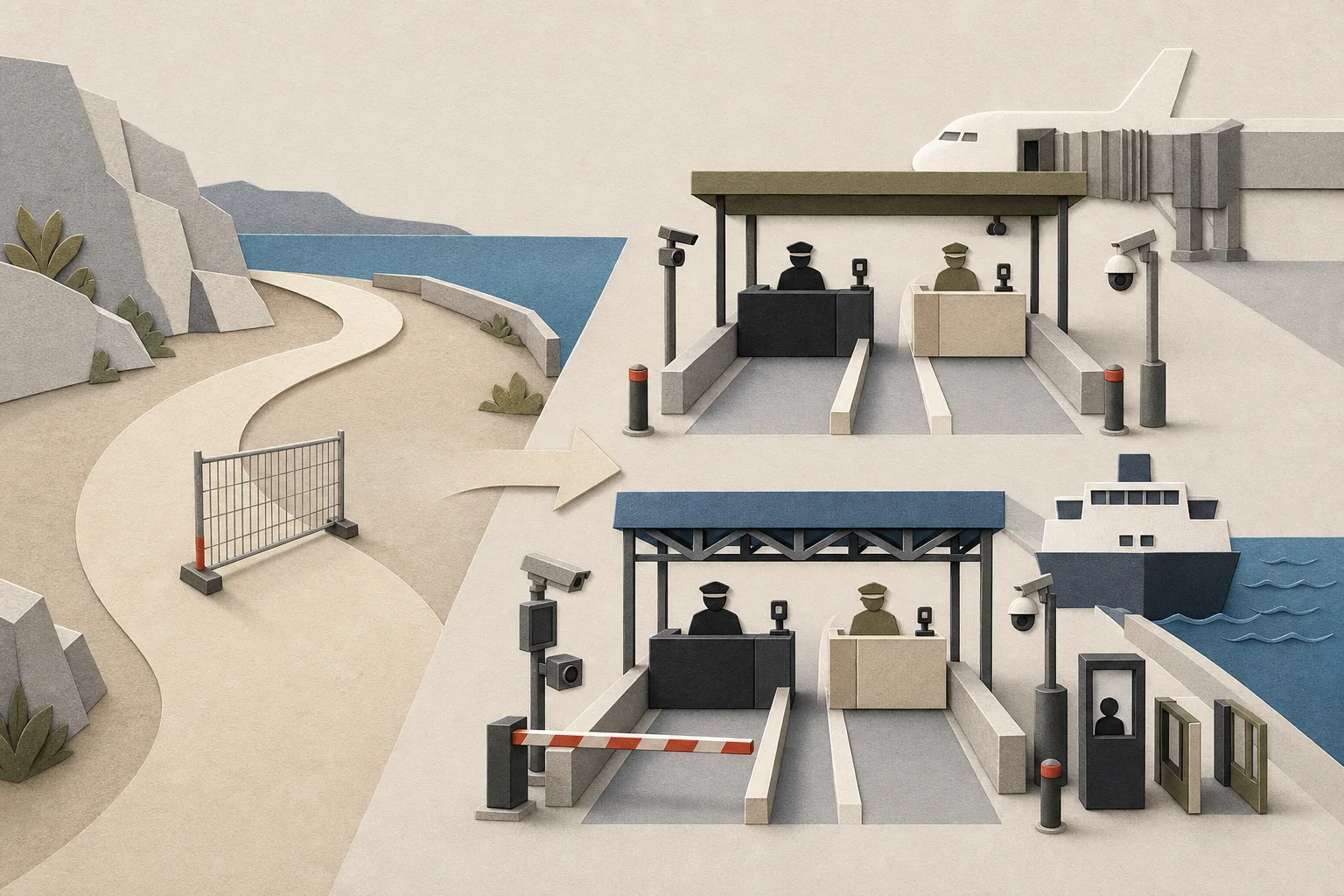
For many local commuters, the benefit should be immediate: fewer routine land-border delays. For travelers arriving from outside the Schengen area, including many passengers from the UK, the key checkpoint becomes the first arrival point at Gibraltar's airport or port.
Gibraltar's government has tried to answer security concerns by saying the old chain-link and barbed-wire sections are not simply disappearing without replacement. In a July 2 statement, it said a high-security fence line already protects sensitive areas near the runway, fuel farm, tunnel and customs installation, while the open pedestrian section will be covered by police, customs, border officers, CCTV, automatic number-plate recognition and live facial-recognition cameras checking wanted lists.
Why it matters beyond Gibraltar
The agreement shows how a small territory can create an outsized post-Brexit problem. Gibraltar was not covered by the main UK-EU Trade and Cooperation Agreement that took effect after Brexit, even though it sits directly beside EU territory and depends on daily movement across a short land frontier.
For the EU, the bargain has to protect Schengen and customs rules. For the UK and Gibraltar, it has to preserve sovereignty and keep the local economy from being damaged by a hard border. For Spain and the Campo de Gibraltar region, the stakes include jobs, traffic, tourism and cross-border family life.
The treaty also carries emotional weight. AP reported that crowds crossed freely soon after midnight, with celebrations boosted by Spain's World Cup semifinal win. The Guardian reported that Spanish Prime Minister Pedro Sanchez visited La Linea de la Concepcion on Wednesday and called the falling fence a step toward coexistence and shared prosperity.
What to watch next
The new system is provisional while the treaty moves through formal ratification. In practice, the first test will be whether the land crossing stays fluid during workday peaks, tourist periods and airport arrivals.
Travelers should also watch how the EU's Entry/Exit System is handled at Gibraltar's airport and port. Biometric checks can slow first-time crossings in other border settings, and Gibraltar's government says e-gates for the system are being installed inside the air terminal.
The bottom line: the fence coming down is a major change for daily travel between Gibraltar and Spain, but it is not the end of border management. It shifts the question from whether people can cross the land frontier easily to whether the new airport, port and security arrangements can keep movement open without creating new bottlenecks.


