
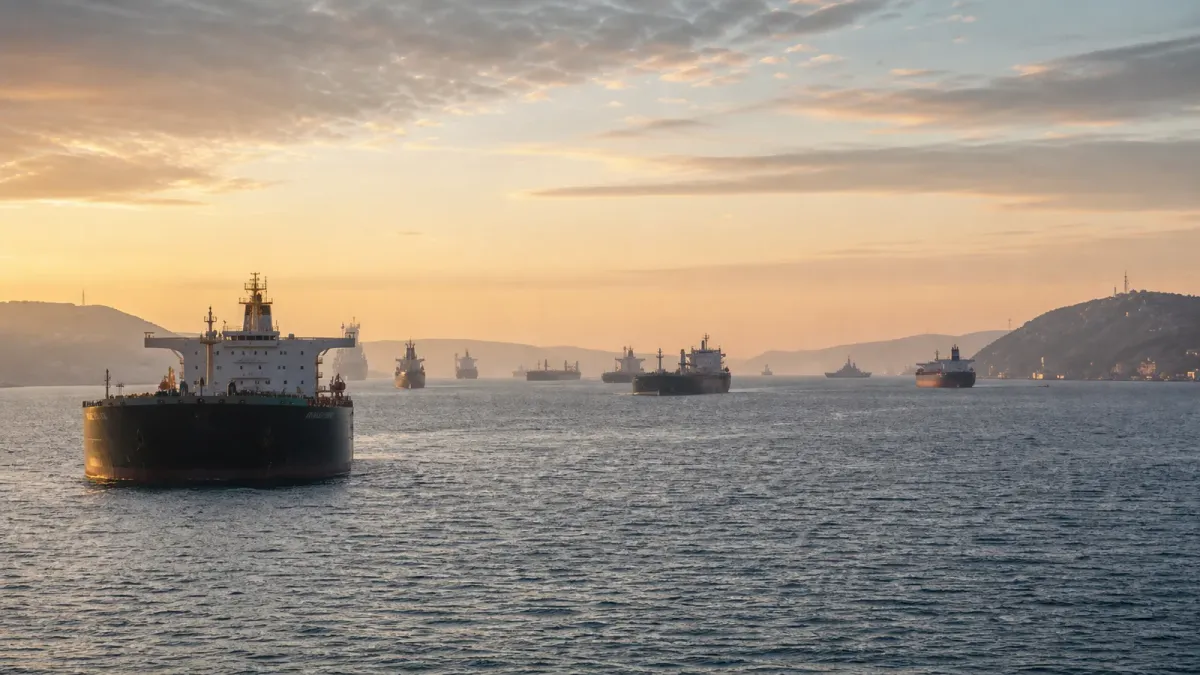
President Donald Trump said Monday, July 13, 2026, that the United States will charge ships for safe passage through the Strait of Hormuz, turning a military standoff with Iran into a direct test for energy markets and global shipping.
The announcement came after another weekend of U.S.-Iran attacks around the waterway. The Associated Press reported that oil prices jumped nearly 5% on Monday before easing, while U.S. benchmark crude traded around $72.92 a barrel later in the session.
The immediate question for consumers and investors is not only whether ships can pass. It is whether insurers, tanker operators and energy buyers will treat the route as reliable while Washington and Tehran are making competing claims over who controls the strait.
What changed
Trump said the U.S. would reinstate a blockade against Iran and charge other ships for protection through the passage. AP reported that the comments followed Iranian attacks on a container ship and a new wave of U.S. strikes on Iranian targets.
U.S. Central Command said on July 12 that it had hit Iranian air-defense systems, coastal radar sites, missile and drone capabilities, and small boats. CENTCOM said the strikes were meant to reduce Iran's ability to attack international shipping, while also saying commercial navigation through the strait should remain available.
Iran has rejected U.S. claims over the waterway, according to AP, and both sides are still inside a 60-day period that was supposed to support talks on ending the war and addressing Iran's nuclear program. That makes the next few days important for both diplomacy and freight planning.
Why markets care
The Strait of Hormuz is not just another shipping lane. The U.S. Energy Information Administration says oil flows through the strait averaged 20 million barrels per day in 2024, roughly 20% of global petroleum liquids consumption. EIA also says about one-fifth of global liquefied natural gas trade moved through the strait in 2024, mostly from Qatar.
That concentration means even short disruptions can raise shipping costs, delay cargoes and push fuel-price expectations higher. Alternative pipelines exist in Saudi Arabia and the United Arab Emirates, but EIA says most volumes that normally pass through Hormuz have limited practical alternatives.
What we do not know yet
The mechanics of the proposed U.S. charge remain unclear. Key open questions include how the fee would be collected, whether other governments or shipping companies would accept it, and whether it would apply only during a declared security operation.
It is also unclear whether Monday's market reaction will last. Traders often price immediate risk quickly, then pull back if ships keep moving and officials signal a diplomatic off-ramp. The risk is that repeated attacks, higher insurance costs or a formal refusal by either side could make the route less predictable even without a complete closure.
What happens next
Watch for three signals: official shipping advisories, tanker traffic through the strait and whether U.S.-Iran talks continue under the 60-day framework. If traffic keeps moving and prices settle, the market may treat Monday's jump as a risk premium. If ships pause or insurers reprice coverage, fuel and freight costs could stay under pressure.


