
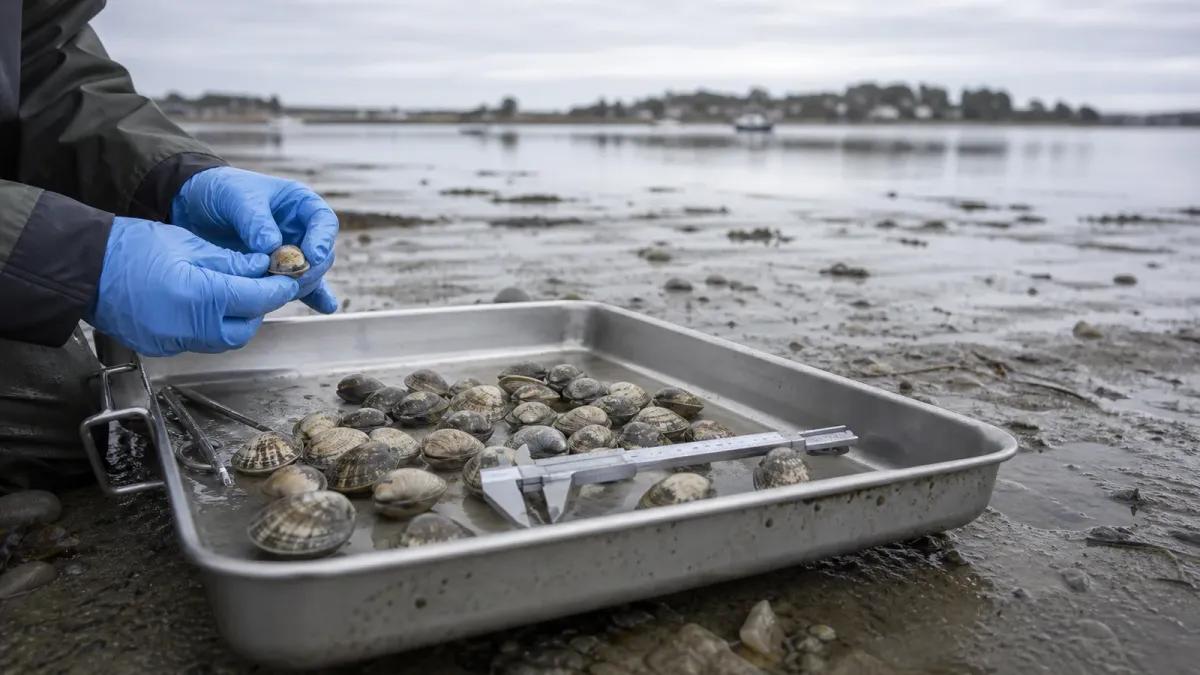
Manila clams, a small shellfish prized in seafood markets and watched closely by invasive-species researchers, are now established in New England waters.
A team led by UMass Amherst, MIT Sea Grant and the Center for Coastal Studies announced on July 7, 2026, that reproducing populations of Ruditapes philippinarum were confirmed in Cape Cod and Boston Harbor. The finding matters because the northwestern Atlantic had been the last major Northern Hemisphere coastline where the species had not been documented as established.
This is not a public-safety alert, and it does not mean beaches or seafood are suddenly unsafe. It is a monitoring story: researchers now have a rare early look at what happens when a widely introduced marine species starts to take hold in a new coastal system.
What changed
The research team found more than scattered shells. UMass said scientists dug up live tiny specimens at Squantum in Quincy and Calf Pasture Park in Boston, using sieve-based sampling that showed recent reproduction and recruitment. On Cape Cod, researchers investigating reports of unusual clams around Provincetown also found evidence that female Manila clams had reproduced.
The peer-reviewed paper in Biological Invasions describes records from multiple Cape Cod and Boston Harbor locations between 2023 and 2025. It also notes northern observations reaching Salem Sound, north of Boston, and calls for more work to understand the likely source and spread.
That timeline is important. The discovery did not come from one dramatic beach event. It came from local reports, field work, community observations and researchers comparing findings from separate parts of the Massachusetts coast.
Why scientists are watching
Manila clams are native to parts of East Asia, including waters from Russia's Sakhalin Island through Japan and southern China. They have spread widely since the early 20th century, both accidentally and through intentional introductions connected to aquaculture and seafood trade.
The concern is that dense colonies can compete with native shellfish, hybridize with similar species and change local ecological communities. The possible upside is that the clams may also become food for crabs, seabirds and other animals, which could shift pressure away from some native species.
That uncertainty is why the next phase is observation rather than alarm. Researchers are trying to map where the clams are, whether the populations are expanding and how they interact with New England species that already face warming waters, invasive predators and changing coastal habitats.
What to watch next
For coastal communities, the practical question is whether Manila clams remain a minor newcomer or become a larger factor for shellfishing, habitat monitoring and local food webs. The answer will depend on follow-up surveys, reports from shellfishers and community science observations over the next few seasons.
People who work or spend time around tidal flats may hear more about surveys and reporting efforts as scientists look for the species beyond the confirmed sites. The useful takeaway is simple: unusual shellfish finds are worth documenting, especially when researchers are already tracking a new arrival.
For readers outside New England, the story is a reminder that invasive-species news often starts quietly: a strange shell, a local report, a field survey and then a scientific paper showing that a coastline has changed.


