
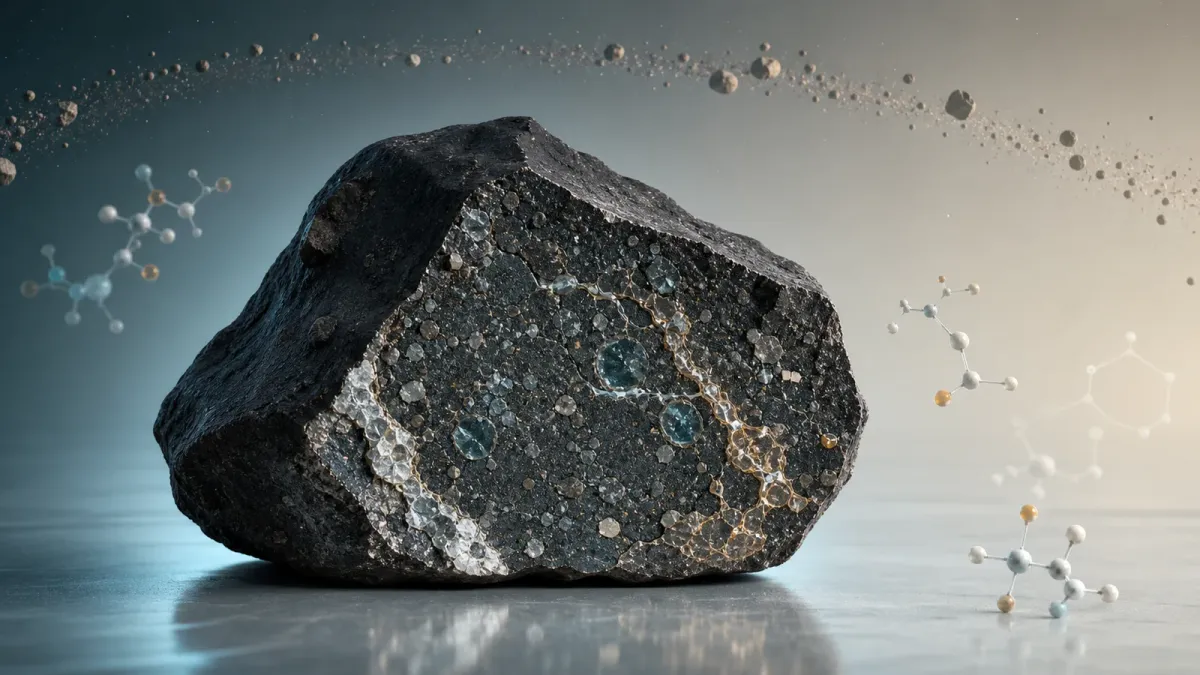
A meteorite that crashed through the roof of a Hillsborough, New Jersey, home in 2024 is back in the news because scientists now say it preserved unusually clear evidence of ancient asteroid chemistry.
The short version: the rock does not show that life exists beyond Earth. It does show that a primitive asteroid once held salty fluids and organic compounds, including amino acids, that are part of the chemistry scientists study when they ask how the early solar system supplied planets with life's raw ingredients.
What scientists found
The meteorite, now officially named Hillsborough, was approved by the Meteoritical Bulletin on July 15, 2026. The bulletin lists it as an observed fall from the United States, with a mass of 1,350 grams and a recommended classification of CM1/2, a rare type of carbonaceous chondrite.
That classification matters because carbonaceous chondrites are primitive, carbon-rich rocks. They can preserve material from the early solar system, including minerals that were altered by water and carbon-bearing compounds that formed before the meteorite reached Earth.
According to NASA and the SETI Institute, researchers found microscopic fractures and sodium-rich material left by ancient brines. Brines are salty fluids, and in this case they appear to have moved through the meteorite's parent asteroid long before the rock broke away and eventually crossed Earth's path.
Researchers also reported a diverse set of soluble organic compounds. NASA said the meteorite's amino acids and other organic chemistry are comparable in some ways to the famous Murchison meteorite, which fell in Australia in 1969 and became a benchmark sample for extraterrestrial organic chemistry.
Why the New Jersey rock was so useful
Many meteorites sit outdoors for long periods before anyone recognizes them. Rain, soil, heat, and ordinary handling can change fragile salts and organic compounds, making it harder to know what was originally in the space rock.
Hillsborough was different. The homeowner recognized the object's potential value, handled fragments with gloves, and stored them in aluminum foil and glass containers soon after impact, according to NASA. That fast recovery helped preserve minerals and compounds that could have reacted with Earth's moisture.
The fall itself was also well documented. SETI Institute researchers said the July 16, 2024, daytime meteor produced reports across several northeastern states, and cameras plus radar helped reconstruct the fireball's path. The Meteoritical Bulletin says the meteor moved over Staten Island toward New Jersey before a recovered piece struck the Hillsborough house.
What 'building blocks of life' means
The phrase can sound larger than the finding. In this case, it means the meteorite contains molecules and chemical conditions that are relevant to prebiotic chemistry, not fossils, cells, DNA, or proof that life formed on an asteroid.
Amino acids are often described as building blocks because living things use them to make proteins. But amino acids can also form through nonliving chemistry. Finding them in meteorites helps scientists test how common these molecules were in the early solar system and how they may have reached young planets.
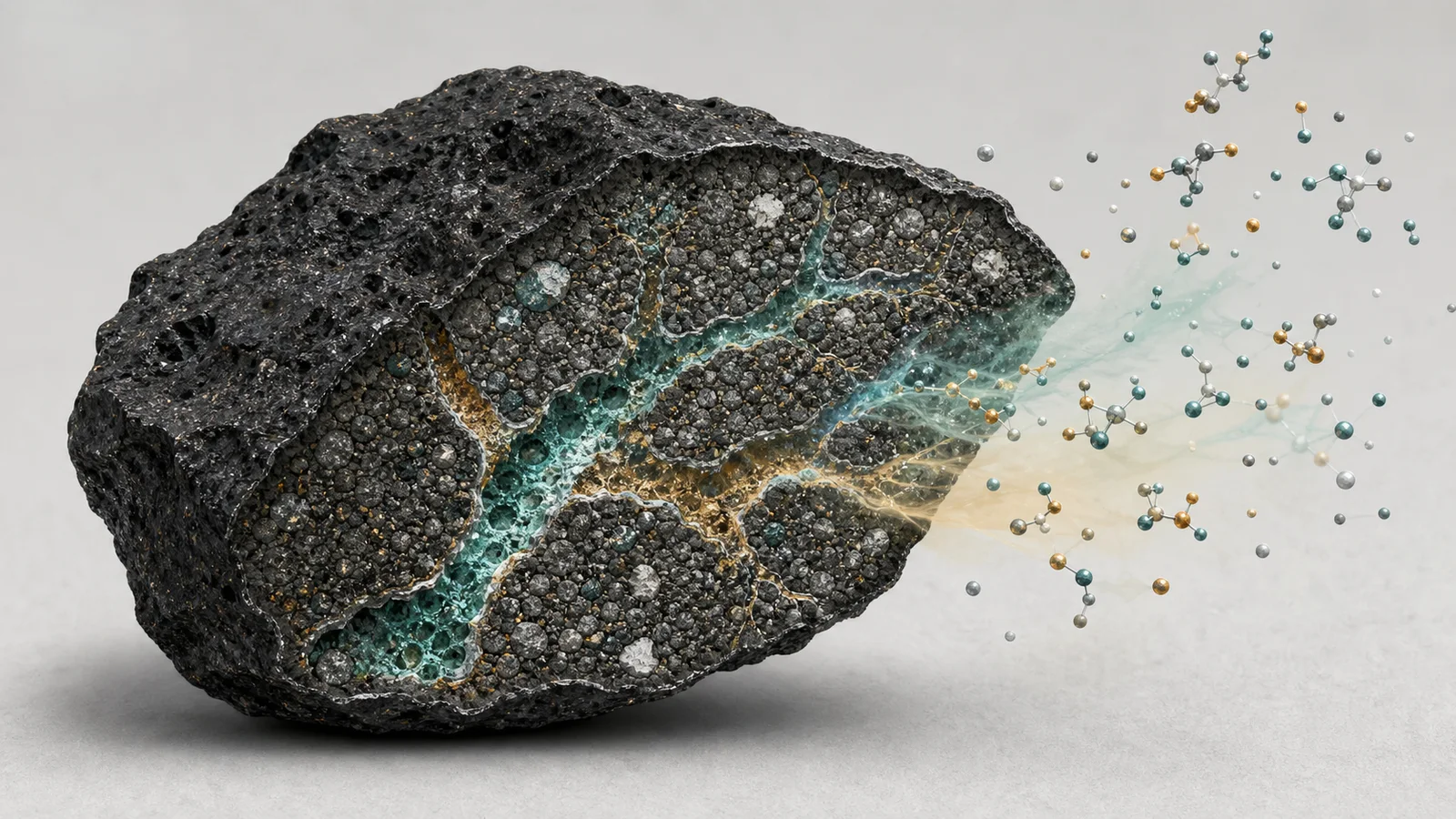
The salt-rich chemistry is the other important piece. NASA said scientists found evidence that ancient brines altered minerals inside the parent asteroid. Similar salts have been studied in samples returned from asteroid Bennu by NASA's OSIRIS-REx mission and from asteroid Ryugu by Japan's Hayabusa2 mission, but Hillsborough gives researchers a rare meteorite comparison from a documented fall.
What happens next
Scientists are still studying Hillsborough to compare its salts, minerals, and organics with other meteorites and returned asteroid samples. NASA said the work can help researchers understand how water moved through primitive asteroids and how those bodies evolved chemically over billions of years.
Some fragments will be curated at the American Museum of Natural History in New York, according to the SETI Institute. That keeps part of the sample available for future study as instruments improve.
The practical takeaway is narrower but still significant: a rock that punched through a bedroom ceiling preserved a tiny chemical record of a wet, salty asteroid environment. For scientists, that is one more clue in the larger story of how water and organic molecules were distributed through the early solar system.


