
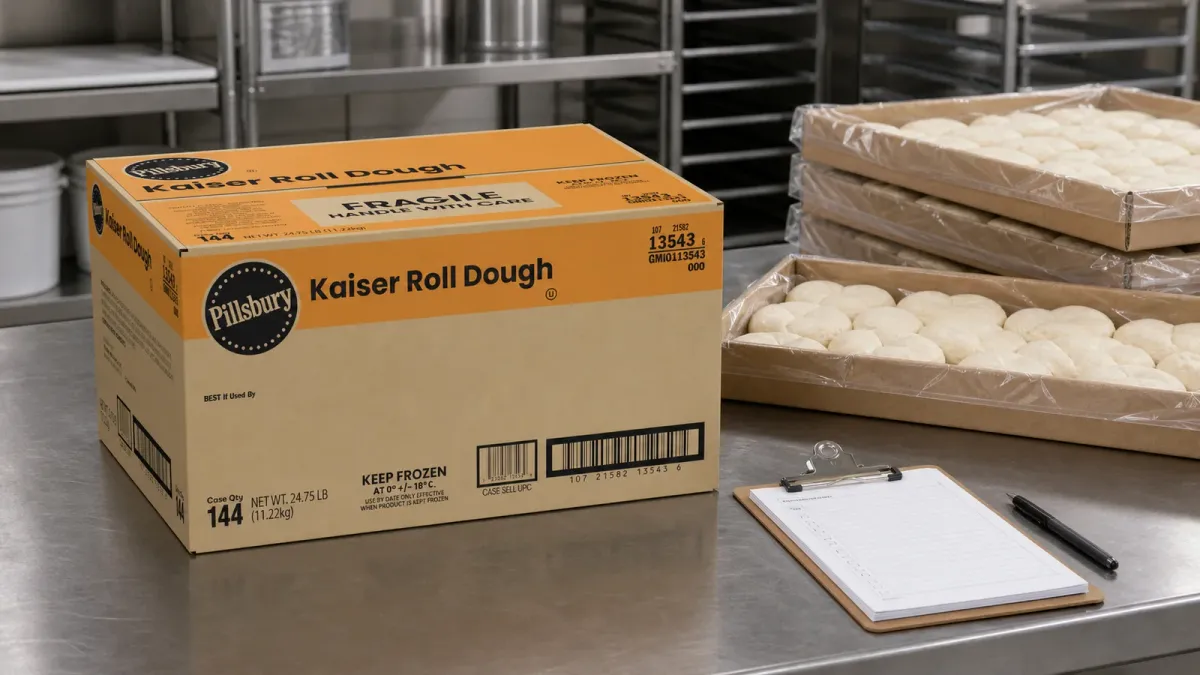
General Mills has recalled bulk Pillsbury frozen roll dough after FDA-listed recall notices cited possible glass contamination, a practical check for food-service operators, bakeries and anyone with access to commercial frozen dough cases.
The recall covers Pillsbury Bread Rolls Hard Roll Dough and Pillsbury Bread Rolls Kaiser Roll Dough, according to recall details reported from the U.S. Food and Drug Administration and confirmed by multiple outlets on July 16 and July 17, 2026.
Check these details first
- Hard Roll Dough: recall number H-1154-2026; 180 units per case; affected better-if-used-by dates include October 12, 2026 and October 13, 2026; reported lot codes include 11JUN6JL and 12JUN6JL.
- Kaiser Roll Dough: recall number H-1155-2026; 144 units per case; better-if-used-by date October 13, 2026; reported lot code 12JUN6JL.
- Total recalled: about 735,840 rolls, based on the recalled case counts reported from the FDA notices.
The products were distributed in 19 states: Arkansas, California, Florida, Georgia, Indiana, Louisiana, Maine, Missouri, New Mexico, New York, Ohio, Oklahoma, Pennsylvania, South Carolina, Tennessee, Texas, Virginia, Washington and Wyoming.
Who is most likely affected
This is mainly a commercial-food-service recall, not a warning about every Pillsbury item in a home refrigerator. The recalled products are bulk frozen dough cases used for back-of-house preparation. General Mills Foodservice describes its Kaiser roll dough as a product operators thaw, proof and bake for service.
That still leaves a consumer-facing question: people who buy prepared rolls from in-store bakeries, cafeterias, restaurants or delis may not see the original frozen case. If you operate one of those kitchens, check inventory records and supplier invoices. If you are a customer and have a specific concern, ask the store or food-service provider whether affected lots were used.
What to do next
Do not serve or use dough that matches the recalled product names, lot codes and use-by dates. Set the cases aside, keep the original labels available, and contact the supplier, distributor or General Mills for return or refund instructions.
The FDA classified the recall as Class II, a category used when a product may cause temporary or medically reversible health consequences, or when the chance of serious harm is remote. Anyone who believes they were injured after eating a recalled product should contact a health care provider.
Sources reviewed for this article included FDA recall listings, the General Mills Foodservice product page, CBS News, AARP and The Guardian.


