
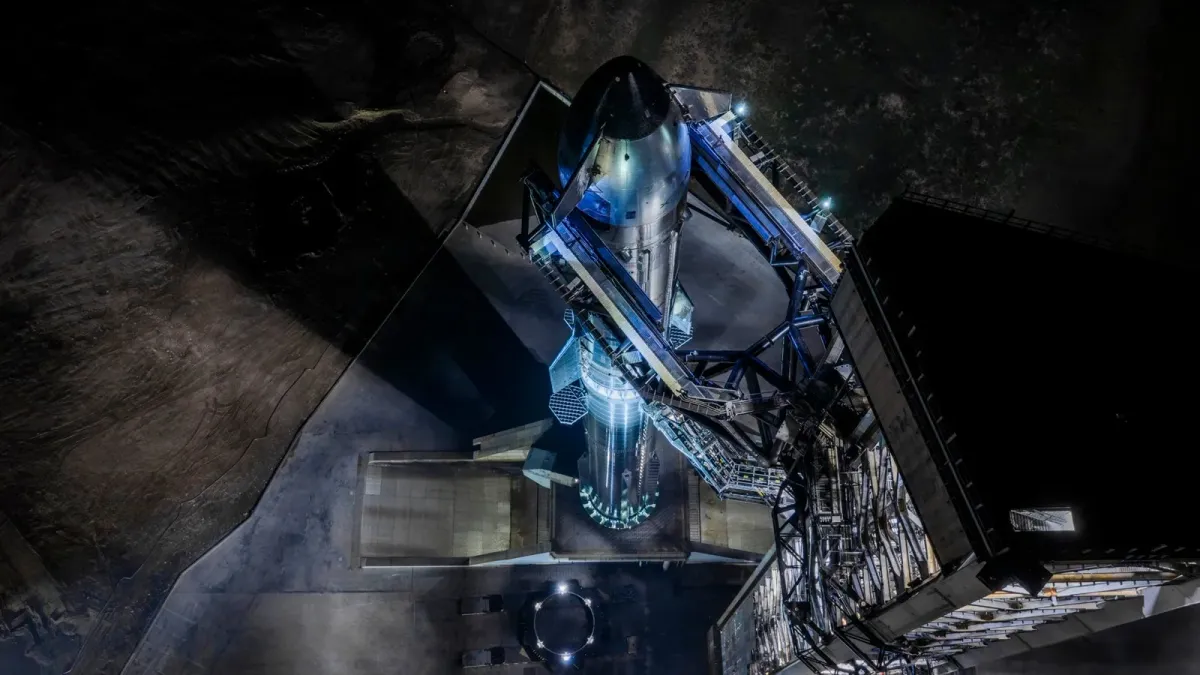
SpaceX set a Thursday, July 16, launch window for Starship's 13th integrated flight test from Starbase in South Texas, with the 90-minute window opening at 5:45 p.m. CT, or 6:45 p.m. ET. The test is not just another countdown: it is designed to show whether SpaceX has fixed problems from the previous Starship flight while also trying the vehicle's first Starlink V3 satellite deployment.
The useful way to watch Flight 13 is to track the test objectives, not just liftoff. SpaceX says the schedule can change, and the company is carrying out developmental testing, which means a scrub, partial success, or early loss of a vehicle would still produce data for the next version.
The short answer
Flight 13 is a technology test for three things at once: Super Heavy booster reliability after stage separation, Starship's ability to deploy payloads and relight an engine in space, and heat-shield data needed before SpaceX can make return-to-launch-site attempts routine.
How the test is supposed to work
On the booster side, SpaceX is looking for a clean launch, ascent, hot-stage separation, boostback burn, landing burn, and offshore splashdown. The company says it changed hardware and software after Flight 12, when the booster's post-separation flip was off target and several engines had trouble relighting for the boostback burn.
The upper-stage Starship has a different checklist. SpaceX plans to deploy 20 Starlink V3 satellites, try a single Raptor engine relight while in space, then guide the ship through entry, descent, and a splashdown in the Indian Ocean. The Starlink satellites are not meant to become permanent parts of the network; SpaceX says they are on the same suborbital trajectory as Starship and are expected to burn up about 20 minutes after deployment.
Why the satellites matter
The Starlink V3 payload makes this more than a rocket handling test. SpaceX says the new satellites are intended to expand network capacity and user speeds, and this initial batch will attempt to extend solar arrays and antennas and connect with the broader Starlink constellation through high-capacity lasers.
Six of the satellites also carry cameras meant to scan Starship's heat shield and send imagery to operators. SpaceX says several heat-shield tiles have been painted white to simulate missing tiles and serve as imaging targets, while other tile and attachment experiments are meant to show how the system behaves under higher stress.
What to watch next
The Federal Aviation Administration remains the key U.S. regulator for Starship and Super Heavy launch and reentry activity, including public safety, licensing, and environmental review at Boca Chica. For readers, the most important post-flight questions will be simple: did the booster relight reliably, did Starship complete the payload and engine-relight demos, and did the heat-shield data support the next step toward reuse?
One timing note matters: the planned payload demonstration begins about 16 minutes after liftoff, the in-space Raptor relight is listed around 39 minutes, and entry follows later in the flight. Those milestones make the middle of the webcast as important as the launch itself.


