
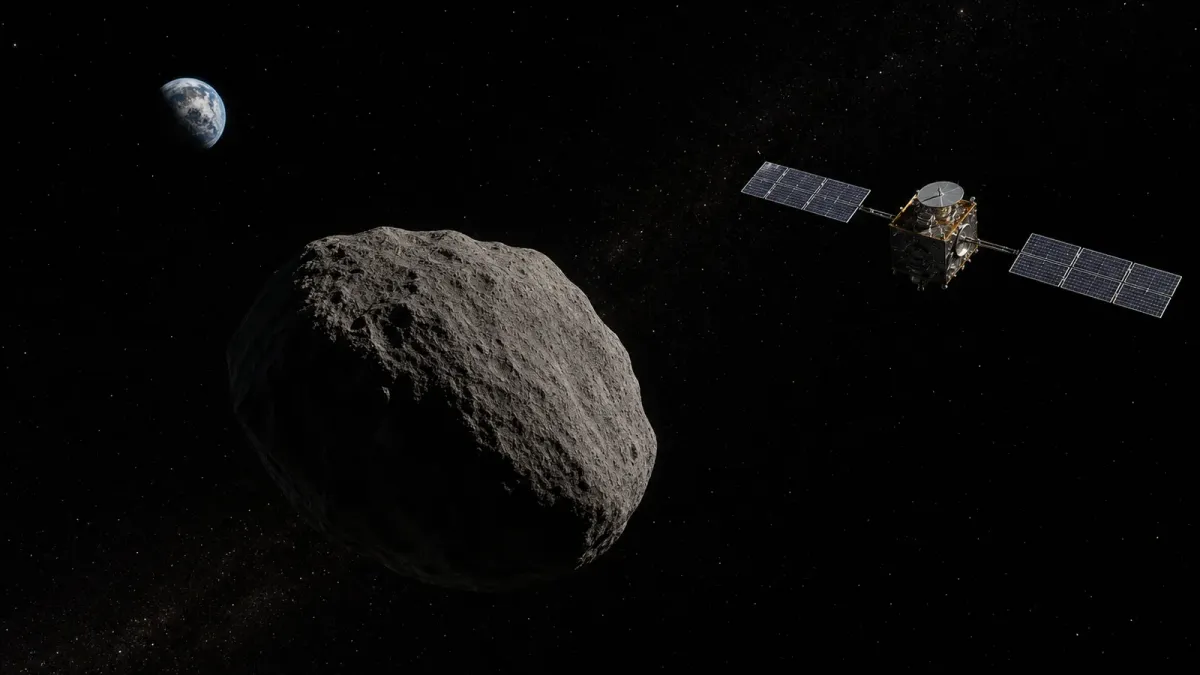
China’s Tianwen-2 spacecraft has returned the first close-up view of Kamoʻoalewa, a small near-Earth asteroid often called one of Earth’s quasi-moons. The image gives scientists their first spacecraft-level look at an object whose origin remains uncertain.
The China National Space Administration announced July 6 that the probe had approached to about 20 kilometers, or 12 miles, after a journey of roughly 400 days and 1 billion kilometers. The released image was taken July 2 and shows an irregular, bright-looking body against dark space.
Why it is called a quasi-moon
Kamoʻoalewa does not orbit Earth in the way the Moon does. It travels around the Sun, but its orbital rhythm keeps it near Earth for long periods when viewed from our planet. Astronomers therefore classify it as a quasi-satellite rather than a second moon.
The asteroid was discovered in 2016 by the Pan-STARRS 1 telescope at Haleakalā Observatory in Hawaii. Its Hawaiian name refers to an oscillating celestial object. Because it is extremely small and usually faint, Earth-based telescopes have struggled to pin down its size, shape and composition.
Some observations suggested Kamoʻoalewa might be a fragment blasted from the Moon by an ancient impact. Other analyses point toward asteroid-like material or a more complicated surface altered by long exposure to space. The new picture alone cannot settle that debate.
What Tianwen-2 will do
The spacecraft launched in May 2025 as China’s first asteroid sample-return mission. After matching Kamoʻoalewa’s path, it began a close survey intended to map the body, measure its physical properties and identify a safe sampling location.
Collecting material from such a small object is difficult because its gravity is extremely weak. Mission planners have described more than one possible sampling technique, allowing the team to adapt to the surface conditions Tianwen-2 finds.
If the collection succeeds, a return capsule is expected to bring samples to Earth in 2027. Laboratory analysis could measure minerals and chemical signatures with far greater precision than remote observations, offering the best test yet of whether Kamoʻoalewa came from the Moon or formed elsewhere.
Why the sample matters
A confirmed lunar origin would help researchers reconstruct impacts that ejected material from the Moon and show how fragments can migrate into unusual near-Earth orbits. A different composition would improve models of the diverse small bodies moving through Earth’s neighborhood.
The mission also serves as a technical test for navigation and sampling around very small objects. Those capabilities can support future science missions and improve understanding of near-Earth asteroids, although Kamoʻoalewa itself is not considered an immediate threat.
What happens next
Tianwen-2 is expected to spend months studying the asteroid and preparing its sampling attempt. After delivering its return capsule toward Earth, the main spacecraft is planned to continue deeper into the solar system toward the active asteroid 311P/PanSTARRS.
Until the sample reaches a laboratory, Kamoʻoalewa’s family history remains a hypothesis. The first close-up view narrows the questions; the material brought home could provide the answer.


