
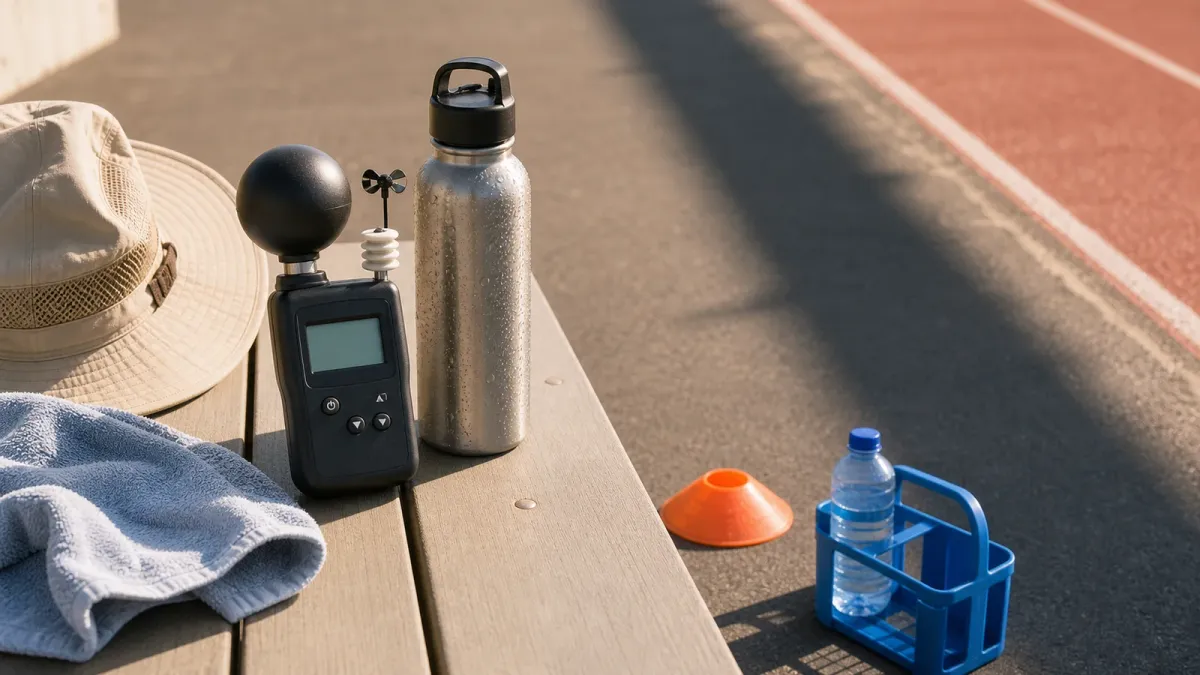
Wet-bulb globe temperature, usually shortened to WBGT, is showing up in more summer weather conversations because it answers a different question than the familiar heat index: not just how hot the air feels in the shade, but how hard it may be for a body to stay cool in direct sun while moving.
The distinction matters during long heat waves, outdoor work shifts, youth practices, road races, festivals and matches. A July 16, 2026 Guardian analysis of World Cup conditions used WBGT to examine heat stress around tournament venues, while the National Weather Service says WBGT is most useful for active people spending time outdoors in physical activity.
The short version: check the heat index for a quick public forecast of hot, humid conditions, but check WBGT when sunlight, wind, clothing, equipment or exertion will decide whether the plan is safe.
What WBGT Measures
The heat index combines air temperature and relative humidity and is calculated for shady, light-wind conditions. WBGT goes wider. The National Weather Service describes it as a measure of heat stress in direct sunlight that accounts for temperature, humidity, wind speed, sun angle and cloud cover, or solar radiation.
That is why two afternoons with the same heat index can feel different on a field, roof, parade route or open jobsite. More sun can raise the body’s heat load. More wind can help cooling. Heavy gear or hard exertion can add metabolic heat even when the public forecast looks only moderately hot.
When To Use Each Number
For everyday errands, school pickup or a shaded walk, the heat index and local HeatRisk forecast are usually the simpler starting points. CDC guidance says HeatRisk gives a 7-day, color-coded view of when heat may pose health risks locally, while the OSHA-NIOSH Heat Safety Tool gives location-based heat index guidance for outdoor work planning.
Use WBGT when the activity is strenuous, sunny or organized: practice, marching band, construction, landscaping, outdoor event staffing, a long run or a tournament. OSHA says WBGT has an advantage because it accounts for temperature, humidity, radiant heat and wind, while the heat index does not account for wind, sunlight, radiant heat sources or workload.
What To Check Before You Go
First, look at your local NWS forecast, HeatRisk level and any heat advisories. Then check the timing: the worst hour may not be the official high temperature if sun angle, humidity and wind line up badly. For an organized activity, ask whether the organizer is using WBGT or another heat policy, what triggers extra breaks, and where shade, water and cooling are available.
Finally, treat symptoms as a stop signal, not a toughness test. CDC/NIOSH lists confusion, slurred speech, loss of consciousness, seizures or very high body temperature as heat stroke warning signs that need emergency care. Heat exhaustion can show up as headache, nausea, dizziness, weakness, thirst, heavy sweating or decreased urination.
Bottom Line
WBGT is not a replacement for common sense or medical advice. It is a better planning number when the body is doing work under sun. If the day involves exertion, direct sunlight, protective clothing, crowds or limited shade, the safer question is not only “how hot will it feel?” It is “how hard will it be to cool down?”


