
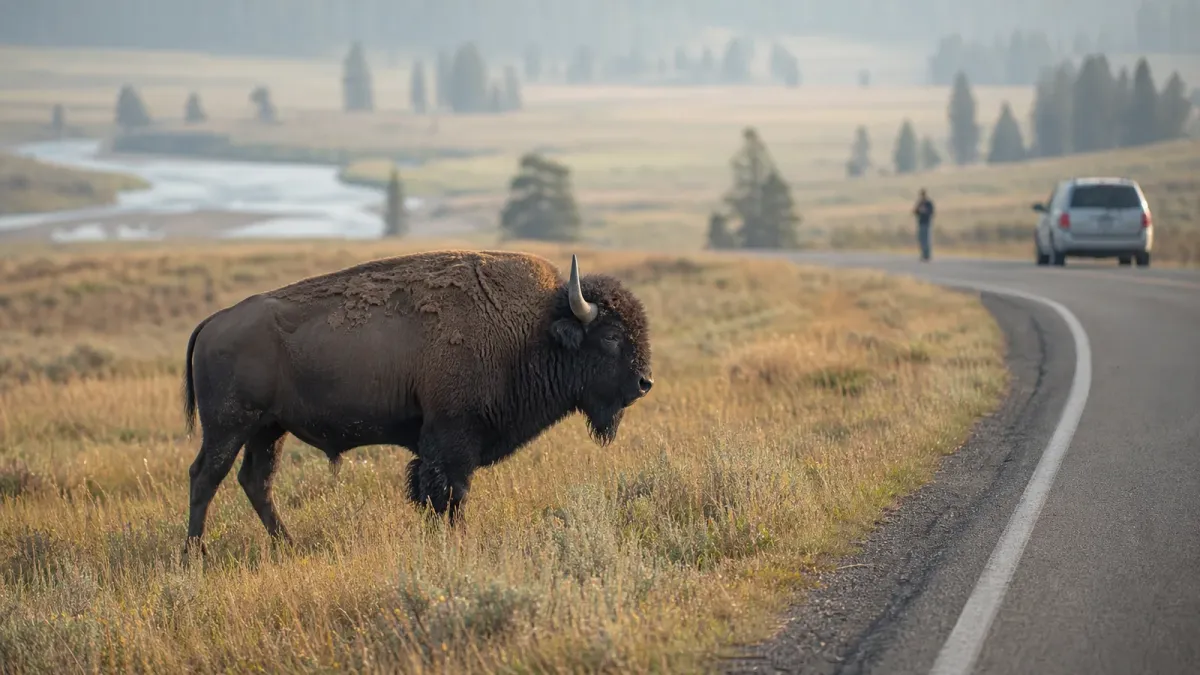
A reported bison attack at Yellowstone National Park's Bridge Bay Campground on July 10 has turned into a fast-moving travel safety story because the video shows how quickly a routine wildlife sighting can become dangerous.
The National Park Service has not released details on that reported incident. The Guardian and Cowboy State Daily reported that a visitor was seriously injured after a bull bison tossed him into the air, while Yellowstone's own safety guidance says bison have injured more people in the park than any other animal.
The practical lesson is simple: visitors should treat bison as unpredictable wild animals, not roadside scenery. Yellowstone tells visitors to stay at least 25 yards, or 23 meters, from bison, elk, deer, moose, bighorn sheep and coyotes, and at least 100 yards from bears, wolves and cougars.
Do this first
- Back away early. If a bison walks toward you, move away to keep the 25-yard buffer instead of waiting to see what it does.
- Do not approach for a photo. A zoom lens or phone crop is safer than stepping closer, even when the animal appears calm.
- Use your vehicle when possible. Yellowstone says the safest way to view wildlife is often from inside a car, with traffic moving slowly and patiently.
- Give yourself an exit. Do not stand between a bison and open space, a road, other visitors or your own vehicle.
Warning signs to recognize
Yellowstone says a bison that feels crowded may bluff charge, bob its head while staring, paw the ground, bellow or raise its tail. Those signs mean you are too close and should leave immediately.
If a bison charges, the park's guidance is direct: do not stand your ground. Walk or run away, use bear spray if the animal follows while you are moving away, and seek cover behind trees or cars.
Why this matters now
The July 10 report follows a separate June 26 Yellowstone release in which the park said a 12-year-old visitor was injured by a bison near Mud Volcano and transported to a nearby hospital. That incident remained under investigation when the park updated the release on July 2.
Summer also brings crowded roads, stopped vehicles and visitors trying to photograph wildlife from short distances. The park tells drivers to expect bison jams, stay in vehicles when bison are on the road, avoid honking, and never drive aggressively toward an animal.
What to check before you go
Before visiting Yellowstone, review the park's current safety and conditions pages, especially if your route includes busy wildlife areas. The safest plan is not just knowing the distance rule; it is deciding in advance how you will move away when an animal closes that distance for you.


