
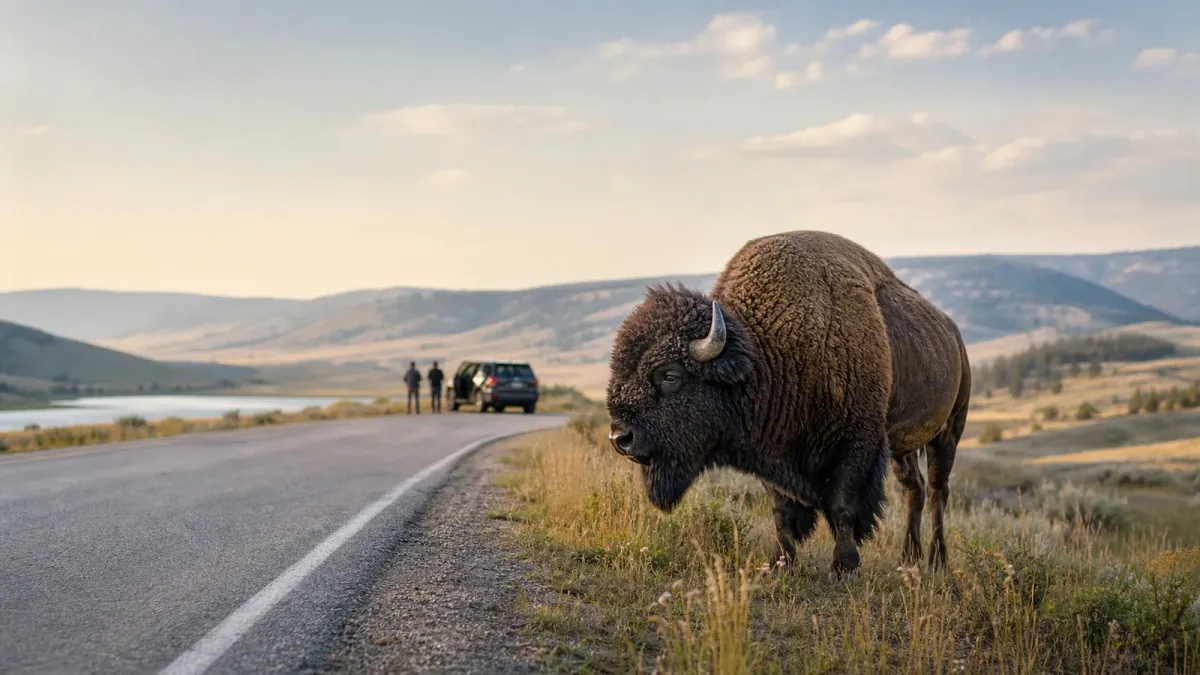
A video showing a bull bison tossing a man at Yellowstone National Park is spreading rapidly online, renewing a familiar summer warning: an animal that appears calm can move with startling speed.
Cowboy State Daily reported that the encounter happened Friday evening, July 10, at Bridge Bay Campground, south of Fishing Bridge. A photographer who recorded the scene said the bison charged through the campground before pursuing a man and his grandson. The report said the man suffered significant injuries. Yellowstone officials had not released information confirming the incident as of the report’s publication, so details about the visitor and his condition remain unverified by the park.
The broader danger is firmly established. In a June 26 news release, the National Park Service said a 12-year-old visitor was injured by a bison near Mud Volcano and transported to a hospital. Park officials say bison have injured more people in Yellowstone than any other animal.
What the park rules require
Yellowstone requires visitors to stay at least 25 yards—about 23 meters—from bison and other large animals. That is roughly the length of two standard city buses. Bears, wolves and cougars require a wider buffer of at least 100 yards.
The rule applies even when an animal is lying down, grazing or appears to be moving away. If a bison walks within 25 yards, visitors should create more space by turning around and going another direction. The park specifically warns people never to approach a bison for a photograph.
Cars and buildings can provide safer separation. Around roadways, Yellowstone advises drivers to remain in their vehicles, move slowly and wait for bison to clear the area. Drivers should not honk or move aggressively toward an animal.
Warning signs that a charge may be coming
According to the park’s safety guidance, a bison that feels crowded may bluff charge, bob its head while staring, paw the ground, bellow or raise its tail. Those signals mean it is time to move immediately.
Unlike the advice commonly given for some bear encounters, Yellowstone tells visitors not to stand their ground when a bison charges. Walk or run away, seek cover behind a sturdy tree or vehicle, and use bear spray while moving away if the animal continues to follow.
Bison can run about three times faster than people. Their size and apparently slow movements can make the available reaction time easy to misjudge.
What remains unclear
The July 10 campground encounter has been described through video and an eyewitness account, but the National Park Service had not issued a public incident report at drafting time. That distinction matters: the footage is a strong reminder of a documented hazard, but claims about the victim’s identity, medical condition or the exact trigger should not be treated as official until park authorities provide more information.
What to do before a Yellowstone visit
Use a vehicle or a long camera lens rather than closing the distance for a picture. Scan the full area before leaving a car, especially near blind corners, campsites and roadside wildlife jams. If an animal changes direction toward you, leave early instead of waiting to see what it does next.
Any wildlife conflict should be reported to a ranger as soon as possible. If cell service is available and someone is injured or in immediate danger, call 911.


